
 Facebook
 X
X LinkedIn
 Forward
Webinar: Observational Science: Reading Beyond the Headlines and What Dietitians Really Need to Know
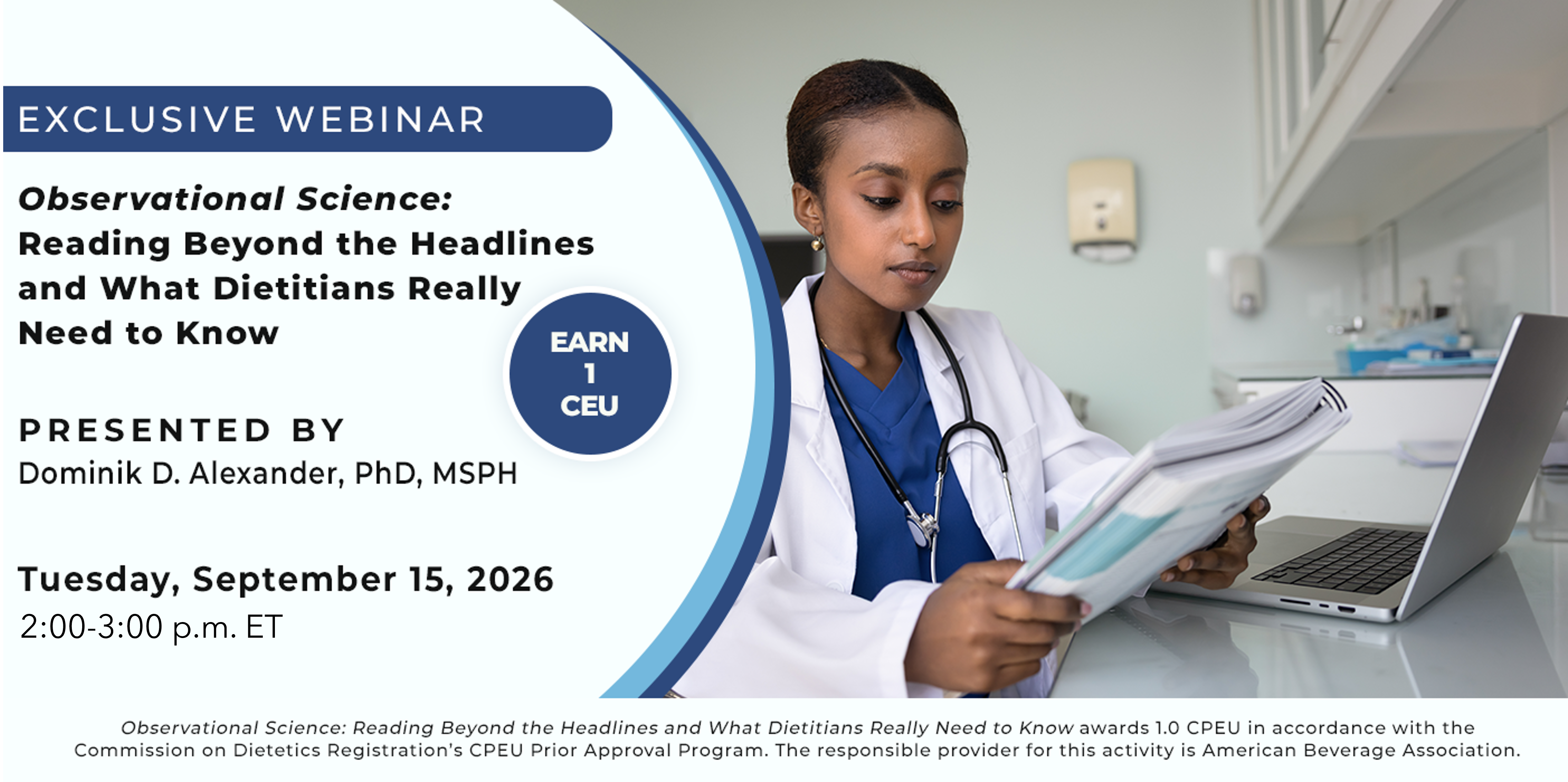
Over the years, observational studies to assess relationships between diet and health have increasingly taken center-stage in the news, with attention-grabbing headlines in the media and on social channels. Misinformation abounds. Unfortunately, observational studies cannot prove causation. In fact, according to the Dietary Guidelines’ Scientific Foundation Report: “Observational studies provide important insights for generating hypotheses and understanding real-world patterns, but they cannot by themselves determine whether a dietary exposure truly causes or prevents disease. (That’s because) People who follow diet guidelines often differ in other ways…that are difficult or impossible to measure and adjust for.”1 It is therefore crucial that dietitians understand the role observational studies play in public health.
Join Dr. Dominik D. Alexander, PhD, MSPH, on Tuesday, September 15, from 2-3 p.m. ET, for a webinar that will help to inform dietitians on how best to interpret and evaluate findings from observational studies and clarify their relevance to public health. The presentation will demonstrate how these studies should be considered when making health and wellness recommendations for patients and clients and will include an explanation of the terminology used in nutrition epidemiology.
Learning Objectives
After completing this activity, nutrition professionals will be better able to:
- Identify three types of observational studies.
- Discuss three main types of bias that can affect observational studies.
- Describe four principles of Bradford Hill’s criteria and why they are used to evaluate causation.
- Explain how observational studies fit into the totality of science that feeds into practical guidance.
- Demonstrate the difference between causation and correlation in nutrition epidemiology.
1. U.S. Department of Agriculture, U.S. Department of Health and Human Services. The Scientific Foundation for the Dietary Guidelines for Americans, 2025–2030. Published January 2026. https://cdn.realfood.gov/Scientific%20Report.pdf
Additional Information
Course summary
- 1.00 CDR
Dominik Alexander, PhD, MSPH, has extensive experience in health research methodology and disease causation assessments, particularly in the conceptualization, design, analysis, and interpretation of epidemiologic studies. He is a leading expert in systematic review methodology and meta-analysis methodology and President and Principal Epidemiologist at MetaMethod, Inc. He has over 210 peer-reviewed manuscripts, professional presentations, published abstracts, and book chapters. Among his many projects, Dr. Alexander currently serves on the editorial boards of the American Journal of Clinical Nutrition and Frontiers in Nutrition Methodology.
Disclosures:
Dominik Alexander, PhD, MSPH, has the following relevant disclosures to report: has previously conducted epidemiologic research supported by grants from American Beverage Association and Coca-Cola.
Observational Science: Reading Beyond the Headlines and What Dietitians Really Need to Know awards 1.0 CPEU in accordance with the Commission on Dietetics Registration’s CPEU Prior Approval Program.
The responsible provider for this activity is American Beverage Association.
Funding from non-CPE revenue for CPE planning, development, review, and/or presentation has been provided by American Beverage Association.
Available Credit
- 1.00 CDR
Price
Required Hardware/software
Ensure your browser's cookies are enabled in order for the webinar software to function properly.