
 Facebook
 X
X LinkedIn
 Forward
Webinar: Mānuka Mastery Part II: Spoonfuls of Science
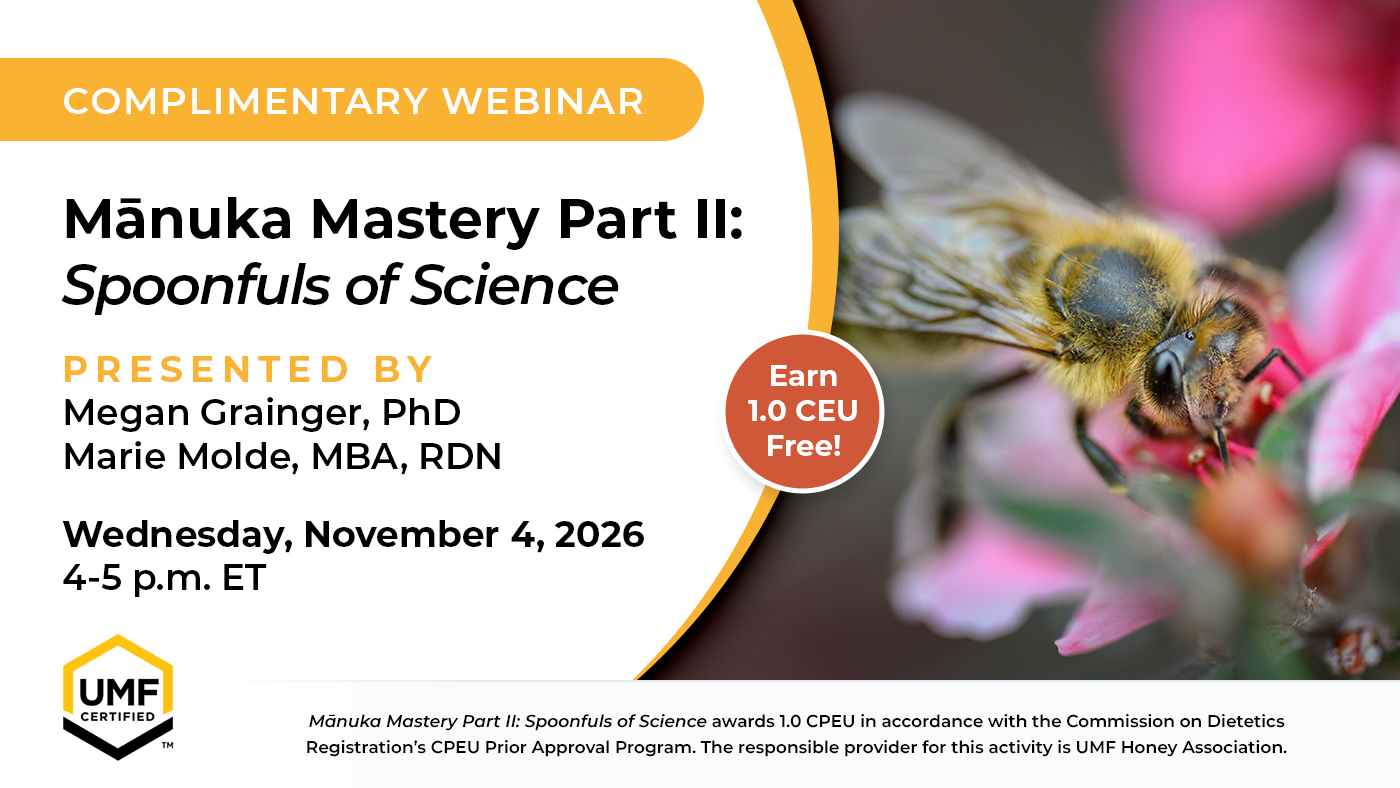
What makes New Zealand Mānuka honey one of the world's most extensively researched natural health foods? Backed by decades of research and growing consumer interest, Mānuka honey has emerged as a compelling case study in evidence-based functional nutrition.
Join Dr. Megan Grainger and Marie Molde, MBA, RDN, on Wednesday, November 4, from 4-5 p.m. ET, to discover what makes New Zealand Mānuka honey one of the world's most researched functional foods. Dr. Grainger and Marie will examine the 40+ years (and growing) body of scientific research supporting use of New Zealand Mānuka honey as a natural health food. Explore the unique bioactive compounds found in Mānuka honey, the mechanisms underlying its antibacterial, anti-inflammatory, and antioxidant properties, and the current body of scientific evidence supporting its role in wound care, oral health, upper respiratory infections, digestive and gut health applications, skin, and emerging immune and metabolic health research. Nutrition professionals will be able to distinguish between well-established and emerging areas of research, helping them critically evaluate the evidence and confidently discuss Mānuka honey in evidence-based nutrition practices. Participants will also gain insight into U.S. consumer perceptions of Mānuka honey and the role of independent UMF certification in verifying Mānuka honey’s authenticity, potency, purity, freshness, and shelf life.
This webinar will translate decades of scientific research into practical, evidence-based insights dietitians can apply in conversations with clients, patients, and consumers.
Learning Objectives
After completing this activity, nutrition professionals will better be able to:
- Define the factors driving consumer interest in bioactive functional foods.
- Evaluate the science around how Mānuka honey supports health across multiple body systems, including throat and upper respiratory support, immunity, and gut and skin health.
- Describe the mechanisms of action behind the antibacterial, anti-inflammatory, and antioxidant benefits of Mānuka honey.
- Recognize where scientific evidence is strongest regarding Mānuka honey’s benefits, and where it is still emerging.
- Incorporate Mānuka honey into evidence-based discussions around oral health, upper respiratory health, digestive health, immunity, and overall wellness.
- Understand how U.S. consumers view Mānuka honey and the key benefits consumers look to Mānuka honey to provide.
- Explain the role of UMF certification in validating Mānuka honey authenticity, potency, purity, shelf life and freshness.
Additional Information
Course summary
- 1.00 CDR
 Megan Grainger, PhD, Director of the Honey Research Unit at the University of Waikato, New Zealand, began her scientific career under the mentorship of Mānuka honey research founder, Dr. Peter Molan, and as part of Professor Merilyn Manley-Harris’ Waikato University team that first identified methylglyoxal (MGO) in Mānuka honey. During her doctoral work, she developed the first predictive model for the conversion of dihydroxyacetone (DHA) to MGO – a forecasting tool now widely used across the honey industry.
Dr. Grainger’s current research focuses on Mānuka honey chemistry, including authenticity testing, phenolic composition, and environmental impacts on honey quality. She also investigates heavy metal uptake in bees to assess potential risks to colony health. Leading a growing research team, Dr. Grainger is dedicated to producing impactful, collaborative science that strengthens the apiculture industry and makes research accessible to the global community.
 Marie Molde, MBA, RDN, is a registered dietitian and consultant to the food and beverage industry. Prior to consulting, Marie worked for Datassential, the leading global food and beverage intelligence platform, helping retail and foodservice brands identify trends and turn them into strategic opportunities for menu and product placements. Marie has served as a subject matter expert on the plant-forward eating trend as a member of the Menus of Change Business Leadership Council and has been featured on CBS News Sunday Morning and quoted in BuzzFeed, The Washington Post, and The New York Times.
Disclosures:
Marie Molde, MBA, RDN, has the following relevant disclosures to report: she is a consultant to UMF Honey Association.
Megan Grainger, PhD, has the following relevant disclosures to report: she is a researcher for UMF Honey Association.
Mānuka Mastery Part II: Spoonfuls of Science awards 1.0 CPEU in accordance with the Commission on Dietetics Registration’s CPEU Prior Approval Program.
The responsible provider for this activity is UMF Honey Association.
Funding from non-CPE revenue for CPE planning, development, review, and/or presentation has been provided by UMF Honey Association. Commercial support has been provided by UMF Honey Association.
Available Credit
- 1.00 CDR
Price
Required Hardware/software
Ensure your browser's cookies are enabled in order for the webinar software to function properly.